

Markets React to Trump's Geopolitical Balancing Act
28th September
Key takeaways
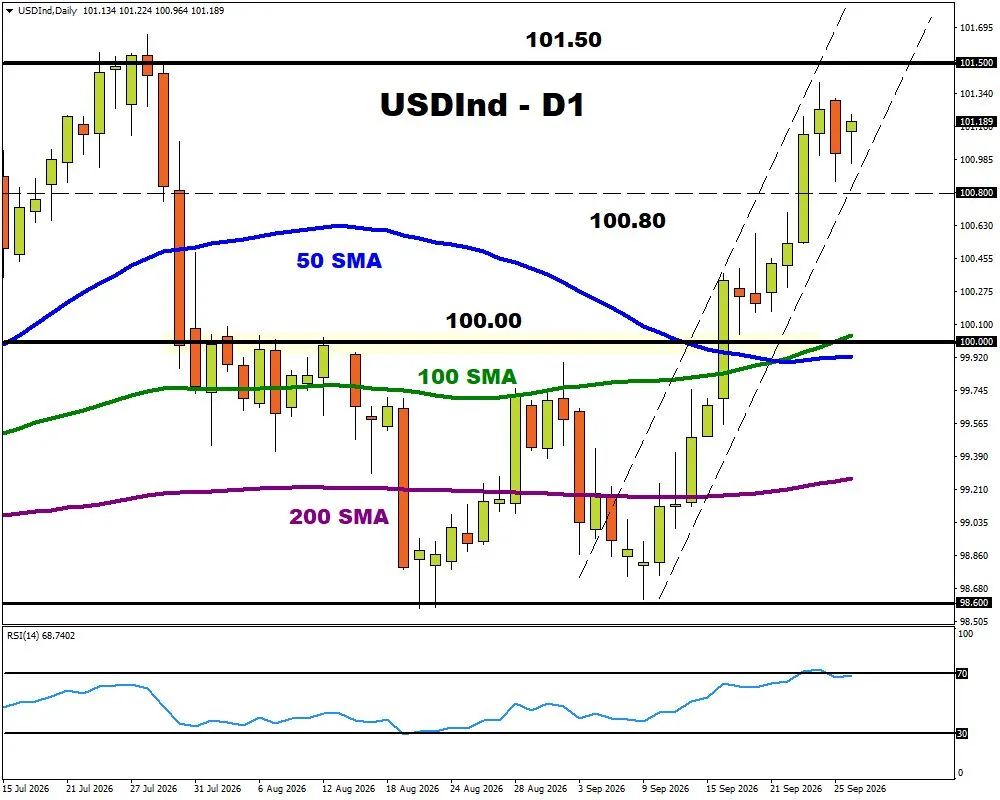
The Dollar Index corrected after a four-day rally but holds above 100, up nearly 3% since the Fed's September hike.
The US and China detailed a $30 billion reciprocal tariff-cut deal, though soybeans and rare earths remain unresolved.
Trump rejected Iran's ceasefire proposal, reportedly expecting to resume military action after the midterms.

Lukman Otunuga
Head of Market Research
The US Dollar Index corrected after a four-day winning streak but remains above the 100 level
,having climbed nearly 3% since the Federal Reserve's September rate hike.
Trump's geopolitical balancing act: Over the weekend, markets focused on two very different signals from Washington — one conciliatory, one combative. Both could shape the dollar's next move.
On trade, the US and China detailed a reciprocal $30 billion tariff-cut arrangement following last week's Trump-Xi summit, with roughly 90% of listed goods set to move to more favourable tariff rates. On foreign policy, President Trump rejected Iran's proposal to reopen the Strait of Hormuz within seven days, reportedly telling aides he expects to resume military action after November's midterm elections.
Key points
- The US and China have detailed a $30 billion reciprocal tariff-reduction framework covering "non-sensitive goods" on each side.
- China will cut tariffs on US agricultural products, wood, cosmetics, and medical devices, and has committed to importing 10 million metric tons of US coal annually in 2027 and 2028. Soybeans remain excluded from the deal.
- Rare earth supply issues remain unresolved and are still under discussion between the two governments.
- Roughly seven months into the US-Iran war, Trump rejected Iran's proposal for a seven-day roadmap to reopen the Strait of Hormuz and resume nuclear talks.
- Iran's proposal called for the US to lift its naval blockade, ease sanctions, and release $12 billion in frozen Iranian assets in exchange.
The following instruments are expected to see exceptional volatility and notable technical momentum this week.
USDInd
What could move the asset:
Bullish factors: markets react positively to the US-China trade deal; US-Iran tensions escalate further; October rate-hike odds climb higher (currently near 67%).
Bearish factors: markets react negatively to the US-China trade deal; US-Iran tensions ease; October rate-hike odds fall back below 60%.
Technical overview:

XAUUSD
What could move the asset:
Bullish factors: the dollar weakens; the US 10-year yield falls; US-Iran tensions ease.
Bearish factors: the dollar strengthens; the US 10-year yield rises; US-Iran tensions escalate.
Technical overview:


Frequently asked questions
Roughly $30 billion in goods each way move to more favourable tariff rates, plus a Chinese pledge to buy 10 million tonnes of US coal annually through 2028 but soybeans were notably left out, and rare earth supply talks are still ongoing.
A seven-day roadmap to reopen the Strait of Hormuz and resume nuclear talks, in exchange for the US lifting its naval blockade, easing sanctions, and releasing $12 billion in frozen Iranian assets - Trump turned it down.
October rate-hike odds sit near 67%, and any further escalation in Iran or a well-received China deal could both push the dollar higher, while easing tensions or fading hike bets would pull it lower.
